What is Amazon ACoS and Why It Matters
When a product you are running Amazon ads on is not able to run successfully and if you ignore your ACoS, you will waste money without knowing whether you're getting any profits or not. Amazon ACoS - Advertising Cost of Sales, which is the number 1 metric that shows whether your ad spend is actually profitable or not. This guide has it all: from newcomers to the selling game figuring out ACoS on Amazon for the first time - to experienced brands/merchants looking to trim wasted spend. What is Amazon ACoS? How do you calculate it? What does good look like? And how do you actually drive it down?
What is Amazon ACoS?
Amazon ACoS (Advertising Cost of Sales) is the percentage of a sale that you paid in advertising to sell that product. This is Amazon's own metric used to measure pay-per-click (PPC) advertising effectiveness.
In simple terms: If you were to spend $10 on ads and through those ads make $100 in sales, then your ACoS is 10%. Numbers come to reflect your ad efficiency, the lower the better. The larger the number, the more you are carrying compared to earning. Learn How to Rank Products on Amazon in 2026.
ACoS Explained For Beginners
You can find ACoS under the Advertising Tab in Amazon Seller Central. It is calculated by default for every Sponsored Products, Sponsored Brands andSponsored Display campaign. You don’t have to calculate it by hand but knowing the formula brings you closer to making more intelligent decisions on how you bid, budget and target.
This is the reason Amazon originally brought ACoS onto the scene as a standard method of measuring advertising efficiency, it relates directly back to how much money you made from that specific ad click. ACoS answers the most important question every seller should ask themselves, and one that can't be answered by vanity metrics like impressions or clicks: am I making money with my ads?
How Can You Calculate Amazon Advertising Cost of Sales? how to calculate acos amazon
Amazon automatically calculates ACoS, but understanding the formula will allow you to model your targets before launching a campaign.
THE ACoS Formula-how to calculate acos amazon
ACoS = ( Ad Spend / Ad Revenue ) × 100
Test1: amazon advertising cost of sales = (total spent / total earned) * 100
Let us say you have a kitchen gadget and you sell it for $45. Let's say also that you run a Sponsored Products campaign over the next 30 days and spend $270. For each $1 spent generating that campaign, it creates $1350 in sales. Their ACoS is: ($270℗÷ $1,350)×100=20%
Now let's say you have 30% margin on your product. 20% ACoS means you're spending 20% of revenue on ads, which gives you 10% net margin after advertising. That's profitable.
Break-even ACoS
Because Your break-even ACoS is your profit margin on the product before paid advertising - known by many as ‘pre-advertising profit margin’ Think about it: If your net margin is 25%, this means that a 25% ACoS means you're covering ad costs, neither losing nor making money on ads. Profitable advertising is any ACoS below your break-even.- 25%
Average Breakeven ACoS for 25% margin product-10–20%
Typical ACoS Range For Established Products.-30–50%
What is good ACoS Amazon for newly launched products?
However, the more you train and examine these numbers, as time goes by, like anything else in life, the better you get at it.
The truth is there is no one-size-fits-all good acos Amazon for ALL sellers. What the number even is varies based on your margin, where your business is in its lifecycle, and what your advertising goal is. With that being said, here are the general benchmarks that most veteran Amazon sellers and agencies run with.
Business Goal
Target ACoS
What It Means
Profitability
Below break-even
Each ad dollar earns back more than where it was spent.
Break-even growth
At break-even
Ads self-fund; rank & reviews grow
Launch / Visibility
Above break-even
Deliberate spending on sales velocity and rank
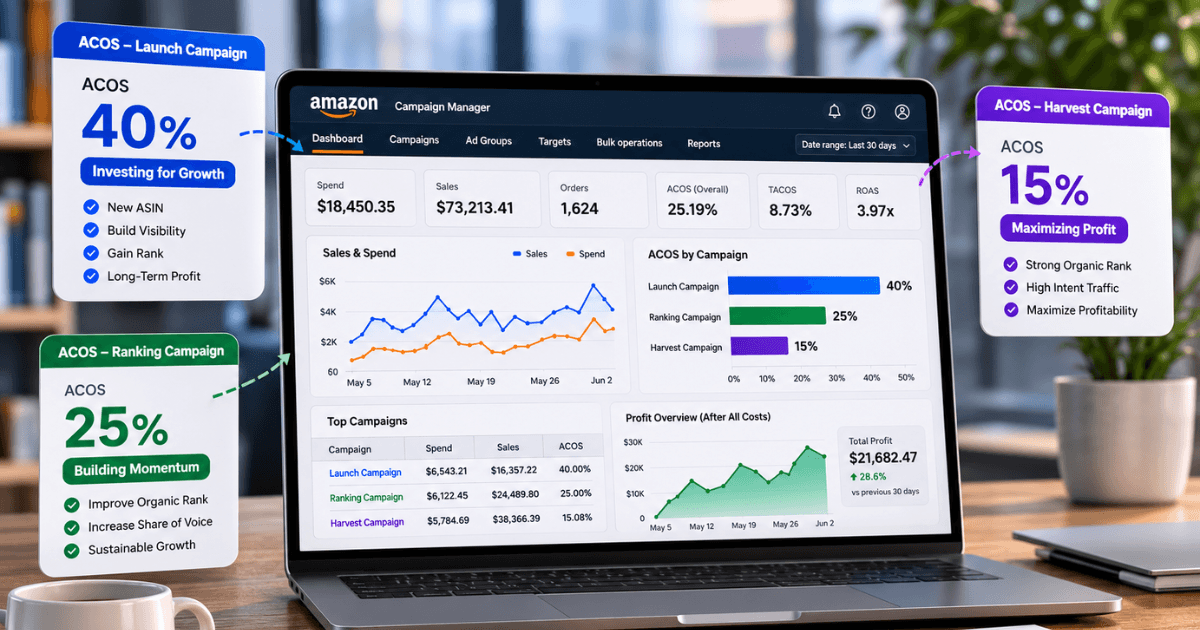
When you have a mature, profitable product on Amazon, then an ACoS in the range of 10-20% is considered good. Since the goal for a new product launch is rank-building, sellers have been known to tolerate an ACOS of 30%, 40%, or even higher as this level of PPC spending will accelerate organic ranking growth.
ACoS - Advertising Cost of Sales
There is no good ACoS for everyone. There is only the ACoS that fits your margins and how you are financially performing right now.
What is the Difference Between Amazon ACoS vs RoAS?
Amazon ACoS vs RoAS - one of the most common areas of confusion for new sellers using Amazon advertising. Both measure the same relationship - ad spend versus ad revenue - but in opposite directions.
With a 20% ACoS, your RoAS is 5x ($5 for every $1 spent) The two metrics have a mathematical relationship: if your ACoS is 50%, then your RoAS is 2x.
Converting Between Metrics
RoAS = 1 / ( ACoS / 100 ) | ACoS = (1/ RoAS) × 100
ACoS is tracked by most Amazon sellers because it is the one provided directly in Seller Central. Brands who advertise on Google, Meta or other platforms often prefer RoAS since this metric is consistent across channels.
ACoS Benchmark by Category
This is one of the more common questions that we receive from sellers: "Is my ACoS rate normal given my category? These are generic ACoS (Advertising Cost of Sale) benchmarks by category drawn from what we have seen reported widely. Consider these as guidelines in the direction, not as hard targets.
Category | Average ACoS Range | Notes |
|---|---|---|
Health & Personal Care | 25–35% | High competition; repurchase value offsets higher spend |
Home & Kitchen | 25–35% | Mid-competition; margins vary widely by product type |
Electronics | 10–20% | Lower margins mean tight ACoS targets are critical |
Sports & Outdoors | 18–28% | Seasonal spikes during summer and Q4 |
Toys & Games | 25–40% | Heavy Q4 competition drives costs up |
Beauty | 20–35% | Strong repeat purchase economics justify aggressive bids |
Pet Supplies | 20–30% | High customer lifetime value supports higher ACoS |
Books / Media | 30–50% | Low price points make efficient ACoS harder to achieve |
PRO TIP
Do not look at your ACoS versus category averages in isolation. But first compare it to your break-even ACoS. So for a brand with 50% margins, a 35% ACoS in Beauty might be perfectly profitable; for one with 30%, it could be devastating.
How to Lower Your Amazon ACoS
It does not mean only lowering your bids. You need a systematic approach to account structure, keyword management, listing quality and conversion rate to build lasting improvement. Once again, those are the best levers.
Weekly Convert On Your Search Term Report - Look for search terms that are getting clicks but 0 conversions. Negative match these terms to eliminate wasting spend on meaningless traffic. This is in almost all regards the fastest win.
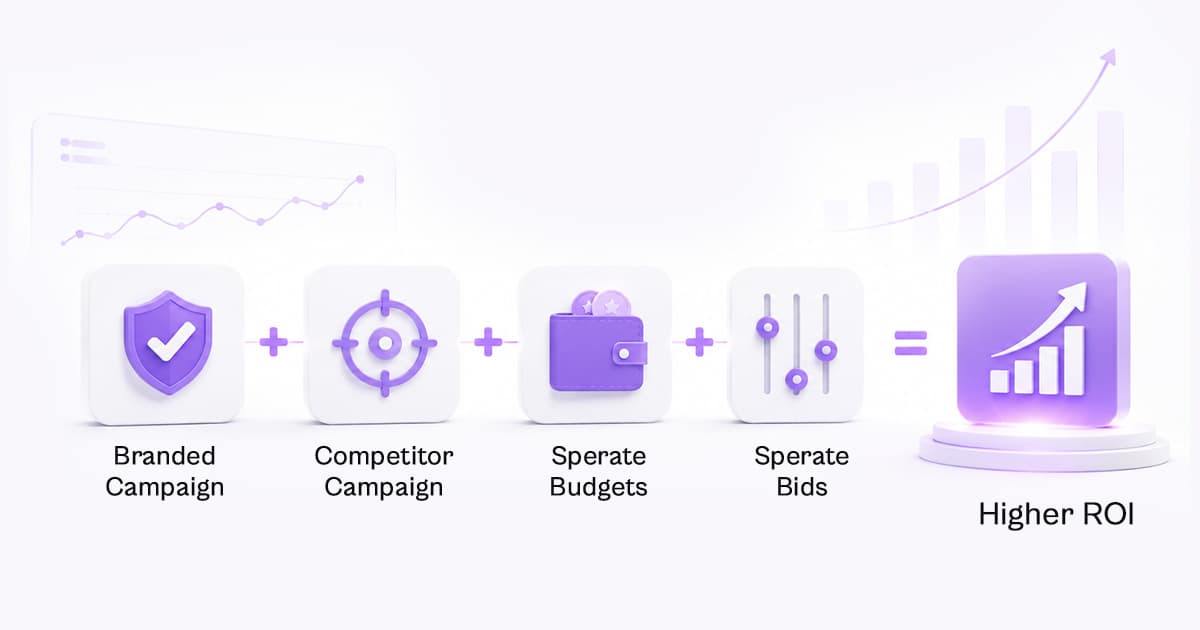
Segregate match types into separate campaigns - Once more, controlling your bids accurately is never going to be possible when you have broad, phrase and exact keywords in a single campaign. Dedicated campaigns provide 100% visibility and control by match type.
Make a better listing - ACoS is partially a conversion rate problem. Whether you bid high or low, if your ad gets clicked by 200 people before they buy even one item (2 in this case), then your cost per sale is too broad for the word. Powerful title, high-quality images and informative bullet points in direct terms lead to an immediate reduction of ACoS by increasing the conversion.
Dayparting and bid scheduling - Look at performance data per hour. The hours between midnight and 5 am result in decreased conversion rates for most categories. Lower bids during the time windows where conversion is low so that you reduce wasted spend.
Develop an extensive review base - Products with 50 or more reviews and 4-or-more star ratings convert at exponentially higher rates. Better bid conversion means more reviews, so at the same bid level you achieve a lower ACoS.
Adjusts price strategically -- Price competitive, which directly correlates to the conversion rate. A 5–10% price drop can meaningfully drive better conversion and lower ACoS - sometimes even without a single bid change.
My Amazon ACoS is so high!
They are the symptom, not the root cause of maintaining profitability with a high ACoS. Diagnose the root cause before you slash budgets The following are the most common reasons why sellers encounter a spike in ACoS:
Conclusion
You might wonder what is a good acos on amazon ppc for your brand. With ACoS targets set higher than legacy Sponsored Products, it typically comes with a justification of intent because Sponsored Brands and Sponsored Display often work in this regard as brand awareness tactics that have downstream value not yet completely measured through only immediate attributed sales.If your metrics look bad, you need to learn how to lower amazon acos fast. Many sellers get stressed and ask why is my amazon acos so high after launching. If you feel lost, an amazon acos explained for beginners guide will help you fix your bids.
The golden rule: determine your ACoS target before you launch a campaign, not once it's happening. To find out, check an amazon acos benchmark by category for your specific niche. Be aware of your break-even, be aware of your goal (whether its profitability vs growth) and then build your bids from the ground up. If your metrics look bad, you need to learn how to lower amazon acos fast. Many sellers get stressed and ask why is my amazon acos so high after launching. If you feel lost, an amazon acos explained for beginners guide will help you fix your bids.
Avail our best Amazon consulting services!
FAQs
What is Amazon acos explained for beginners?
Ans: Stands for Advertising Cost of Sale on Amazon.
ACoS = Advertising Cost of Sales This is Amazon's measurement of how much of your advertising-attributed revenue you spent on ads. This is a percentage value - the higher the number, the more efficient you are with your ad spend.
How to lower amazon acos? Is a lower ACoS better?
Ans: Not necessarily. If you've got a pretty low ACoS (sub 5%), it may be that your bids are too conservative and you're missing out on sales volume that would ideally help your organic ranking. Your margin, your product's stage on Amazon, and your current business objective all come into play when deciding what constitutes the optimal ACoS.
ACoS and TACoS: what are the differences?
Ans: ACoS considers ad spend, and compares it only to ad-attributed revenue. TACoS (Total Ad Cost of Sales) compares your ad spend to all store revenue - organic sales included. TACoS provides a fuller view of the impact that advertising has on your larger business.
How long does it take to improve ACoS?
Ans: The detailed impact on ACoS by making structural adjustments to your campaigns can take up to 30–60 days, because it takes time for Amazon's algorithm to adapt and recognize bidding or targeting changes you have made. Net negative keyword work and bid adjustments show results faster - often in one to two weeks. Learn amazon acos benchmark by category.
The ACoS can be found in the Seller Central fast statistics section
On Seller Central, log in and go to Advertising > Campaign Manager, then select the campaign or ad group you want to check. ACoS is written as a separate column in the default performance table. You'll also view it in the Search Term Report (located in your Reports section) for keyword level ACoS data.
What does high ACoS mean on Amazon? Why is my Amazon acos so high?
Ans: The usual suspects are: irrelevant traffic from broad match keywords without negatives, a poor listing that doesn't convert clicks to sales, overbidding relative to your margins, or an ad on a new product with no social proof built by reviews yet.
Need Help Fixing Your ACoS? how to lower amazon acos?
Ans: Our Amazon PPC specialists have experience managing more than $50M in ad spend. To give you a clear idea of where your ACoS is leaking through we will conduct an audit on your campaigns.

Vishal Barot
vishal@esellerworld.com
Vishal Barot is an Amazon marketplace expert specializing in high-converting product listings, content strategy, and growth-driven ideas. With deep knowledge of Amazon SEO, buyer psychology, and platform policies, he helps brands create optimized listings that improve visibility, boost conversions, and drive sustainable sales.